Full vs. Partial Range of Motion: What Counts for Muscle Growth – and Which Apps Help
Full range of motion or partial reps? What the research says about muscle growth and strength, why the stretched position matters, and which apps help.
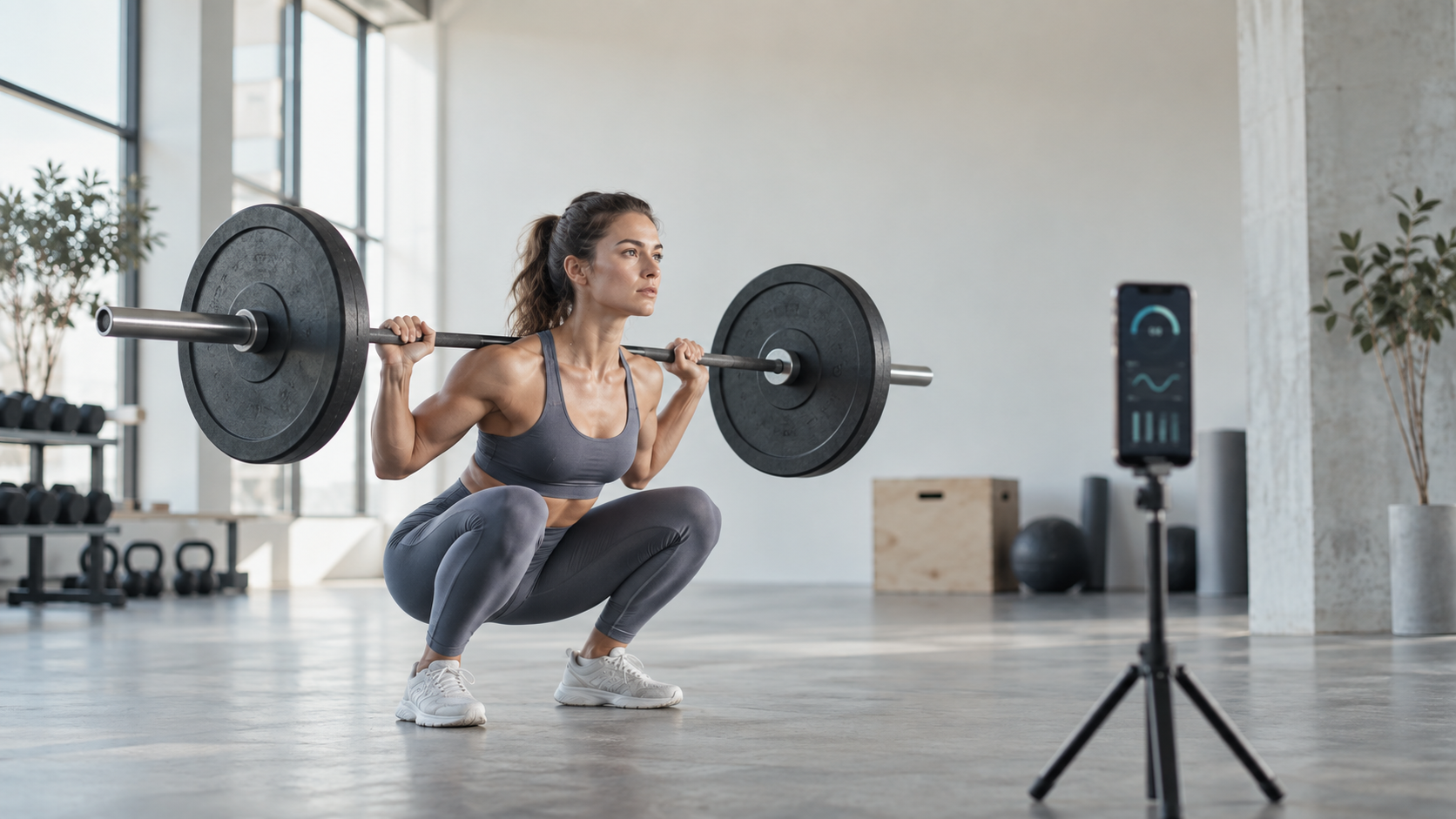
Few details in strength training get overlooked as often as range of motion – the question of how far you actually take an exercise. Many lifters unconsciously shorten their reps: the squat only goes halfway down, the bench press stops well above the chest. Yet this single detail helps decide how much muscle and strength you end up building. In this article we look at what the research says about full versus partial range of motion – and how training apps help you train cleanly and under control.
What does range of motion (ROM) mean?
Range of motion (ROM) describes the distance a joint and the working muscle travel during a repetition. A rep through a full ROM uses the complete path from the muscle's stretched to its shortened position – in a squat, for example, at least until the thighs are parallel to the floor. Partial repetitions, by contrast, cover only a section of that path.
The stretched position plays a special role here. So-called "lengthened partials" are partial reps performed exactly in the range where the muscle is under the greatest stretch – such as the bottom half of a biceps curl. They are not the same as the often-criticized habit of doing "half reps" in the easy, upper part of the movement.
What does the research say?
Muscle growth: the stretched position counts
A systematic review by Schoenfeld and Grgic (2020) pooled six controlled studies with 135 participants in total. The result: for the lower-body muscles, training through a full range of motion produced clear advantages for muscle growth over partial reps. For the upper body the evidence was more limited and less consistent, and the authors noted that the response to range of motion may be muscle-specific.
More recent work sharpens this picture. A 2025 study published in PeerJ had 25 trained individuals train one arm through a full ROM and the other arm with lengthened partials (roughly 50% of full ROM) over eight weeks. Both conditions produced comparable growth in the biceps and triceps as well as similar strength gains. The takeaway: it is not the length of the movement in itself that matters, but that the stretched range is covered. Using a full range of motion includes that range automatically.
In practice this means a clean, complete range of motion is the safest choice for muscle growth in the vast majority of cases – and targeted lengthened partials can be a useful addition, not a free pass for generally shortened reps.
Strength is often ROM-specific
For pure strength development, one important extra rule applies: strength gains are largely specific to the joint-angle range in which you train. Someone who only performs partial reps at a certain joint angle will get stronger mainly in exactly that range. That can be useful for competitive powerlifters or for deliberately overcoming a sticking point – but for most recreational lifters who want usable strength across the whole movement, the full ROM is the better default.
When partial reps make sense
Partial reps definitely have their place. They are useful, among other things, when you add a few lengthened partials at the end of a set after reaching technical failure, to add extra stimulus. With mobility restrictions or when returning from an injury, a deliberately reduced range of motion can also be a sensible intermediate step. The key is that the shortening is a conscious decision – and not the result of too much weight on the bar.
How to apply ROM in practice
The most important lever is honest weight: reduce the load enough that you can control every rep cleanly through the full range of motion. This ties in closely with proper progressive overload – progress only counts when the execution stays the same. Equally important is proximity to failure: how hard a set really is can be managed through concepts like RIR and RPE without sacrificing technique.
Film yourself from the side now and then to check whether your squat, row or bench press really takes the full path. Under fatigue in particular, range of motion often shrinks without you noticing.
Which apps help
A full range of motion stands or falls with technique – and this is where several apps come in. For guided sessions focused on clean execution, Movyn is worth a look, our winner in the "Best Guided Workouts" category. If you want real coaching with feedback, Trainwell connects you to actual trainers who comment on videos of your form.
To understand correct execution, apps with detailed exercise libraries help: Gymstreak offers 3D demonstrations, and Jefit scores with a large database of animated exercises. For structured logging and tracking progress over time, HIT Trainer – our "Editor's Choice" and top pick for strength training – and Push-Pull for fast set logging and clear progressive overload are both strong options. That keeps the focus where it belongs: on quality rather than just rep count.
Conclusion
Range of motion is not a side issue but one of the levers that help decide how successful your training is. For muscle growth, the full ROM – or at least consistently using the stretched position – is the best choice in most cases. Strength gains, by contrast, fall heavily within the trained joint-angle range, which makes targeted partial reps interesting for specific goals. In the end the rule is: better to use slightly less weight and perform every rep cleanly and completely. The right app helps you stick to exactly that day to day.